BPS masses and the stability of particles
Before this lesson: Calculate the periods and effective coupling; Monopoles, dyons, and a physical BPS bound.
An exact formula assigns a central charge to every integer charge row. Does that produce a particle for every row? No: a formula for the energy of a hypothetical state cannot establish that the state belongs to the Hilbert space. The distinction becomes observable when a stable particle disappears at a multiparticle threshold.
Read the physical monopole bound and the normalized period calculation first. We will calculate a possible W-boson decay threshold, then compare its kinematics with the known spectrum on the two sides of a wall.
The theory is pure four-dimensional N=2 Yang–Mills on flat Lorentzian spacetime. It has eight real supercharges, with four manifest in an N=1 presentation, and gauge rank one. A generic Coulomb vacuum preserves all eight. A massive BPS particle preserves four combinations; its presence does not reduce the supersymmetry of the vacuum. There is no mass deformation or curved background here.
Calculate three central charges
Section titled “Calculate three central charges”Fix , , the period column , and the particle charge row . In the first-paper normalization,
The periods and have mass dimension one; has dimension two. Equality defines a BPS state if that state exists. The W boson has electric charge in this package. There is no dynamical fundamental matter. This normalization is the one in Seiberg–Witten (4.3)–(4.5).
At the finite point , use the real branch , established by the period integrals. It lies in the chamber connected to weak coupling; itself is not a parametrically large- approximation. Direct evaluation gives
Consider the following charge rows:
| Species | Charge row | Central charge | BPS mass in units of |
|---|---|---|---|
| Monopole | |||
| Anti-dyon | |||
| W boson |
Here “anti-dyon” denotes the charge opposite to the vanishing dyon in the lower-approach convention of the monodromy lesson. Charge conservation permits the proposed channel because
Its two-particle threshold is nevertheless higher by . A W at its BPS mass cannot decay through this channel at that vacuum. The identification of these rows as existing particles uses the spectrum; the arithmetic alone supplies the bounds and the threshold test.
Change coordinates without changing the particle
Section titled “Change coordinates without changing the particle”An electric–magnetic frame is a choice of period coordinates and corresponding integer charge coordinates. For an integral determinant-one matrix ,
For example, , requires . The monopole row becomes , but its central charge remains . The row’s changed appearance does not make it a newly discovered dyon.
Equation (SW12.3) compares descriptions at one vacuum. Transport around a puncture is an additional operation: the periods are analytically continued along a specified path. A particle can also encounter a stability wall along that path. Period monodromy and particle survival are therefore separate questions.
Derive the marginal threshold
Section titled “Derive the marginal threshold”Suppose an existing BPS particle of charge could decay into particles with charges . Charge conservation and the bound give
Energy conservation for a decay requires the initial rest mass to be at least the final rest-mass sum, with any extra energy going into motion. Thus a BPS decay can reach threshold only when both inequalities in (SW12.4) are equalities. Every massive constituent must itself be BPS, and its nonzero central charge must point in the same, rather than opposite, complex direction.
For two constituents write and , with . Their central-charge threshold deficit is
It vanishes precisely when the phases agree modulo . Near alignment, . This is a kinematic deficit, not a calculation of a binding potential.
A wall of marginal stability is a locus of vacua at which such nonzero constituent central charges align. In a generic one-complex-dimensional Coulomb branch this is one real condition, hence a curve. It is neither a branch cut chosen for a formula nor necessarily a singularity of the low-energy action. The argument is the triangle-inequality mechanism of Seiberg–Witten (4.8)–(4.9).
Follow the W threshold to an actual wall point
Section titled “Follow the W threshold to an actual wall point”For (SW12.2), set on a patch where . Then
The open interval matters. The condition also includes opposite-phase configurations and the endpoints where a constituent becomes massless. In particular, and, for real , exactly on that interval.
Continue the periods from through the lower half-plane, consistently with the chosen dyon charge. Along the negative imaginary ray, a numerical solution of (SW12.6) is
Both constituent masses are , and their sum equals the W bound. The derivative ratio at the same point is . It remains positive in imaginary part. The real ratio diagnosing the wall is not the effective coupling .
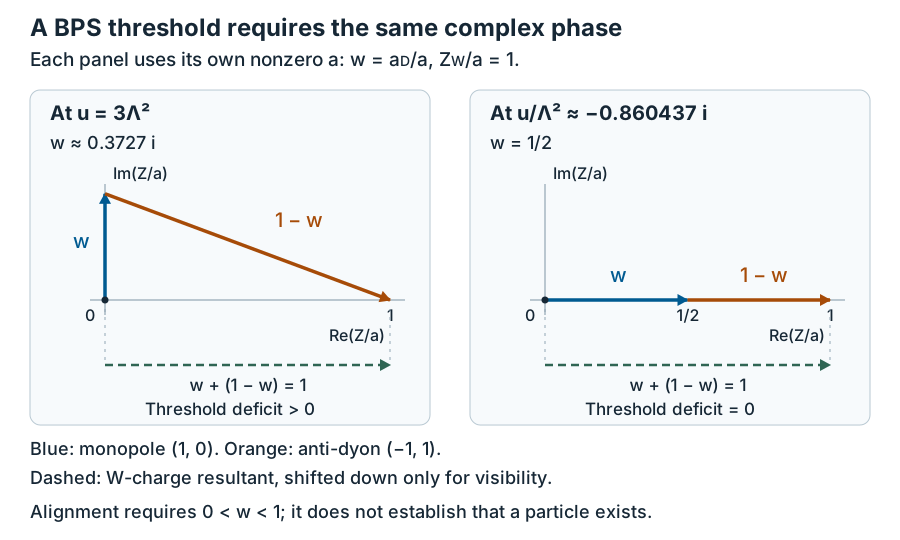
Dividing by the same nonzero in each panel rotates and rescales the central-charge plane: the two constituent vectors become and , with resultant 1. At the wall point their phases agree and their lengths add. The dashed resultant is translated downward only to keep it visible. A real alone is insufficient: this channel requires . This is threshold kinematics; the existence of the particles requires the separate spectral information below.
The endpoint-smoothed period integrals give the following useful diagnostic:
The deficit is positive on both sides. Consequently its sign cannot tell us on which side the W exists. On one side the number in the third column is an actual particle mass; on the other it is only the mass a BPS state of that charge would have.
There is an independent numerical check. Propagating the period equation from along the same lower path reproduces (SW12.7). The Wronskian gives . On this ray the electric integral obeys with : pair its integrand at angles and to see the conjugation relation. Consequently , so the displayed crossing is transverse and unique on this ray. Near it the deficit vanishes quadratically in , with coefficient approximately . These tests locate and characterize this wall point; they do not compute the particle spectrum.
Supply the missing spectral information
Section titled “Supply the missing spectral information”For this pure theory, the standard strong-coupling chamber has the monopole and dyon hypermultiplets, together with their charge-conjugate partners. In our chosen continuation these charge directions are and . The weak-coupling chamber also has the W vector multiplet and the tower of dyon hypermultiplets with charges , , and their opposites. This is spectral information, represented by Gaiotto–Moore–Neitzke (2.26), rather than a consequence of substituting integers into (SW12.1).
On the ray just studied, is on the weak side and on the strong side. The W exists at the former and is absent at the latter. The positive deficit at both samples therefore has exactly the limitation anticipated above.
Their example uses electric-first rows , with W charge and constituent charges and . The translation for these particle data is
Thus their bound agrees with ours. This is a change of charge unit and central-charge normalization, not an additional integral basis change of the same period column. It does not change the microscopic global group.
The antisymmetric electromagnetic pairing in their electric-first example becomes . Its value on the ordered pair is . The factor two reflects the W charge unit relative to the minimal electric probe; it must not be replaced by the unit geometric intersection of the two normalized curve cycles.
What can jump is conveniently recorded by a protected helicity index. At a fixed massive charge, after removing center-of-mass motion, define
Here is one component of the rest-frame spin. A hypermultiplet contributes , a BPS vector multiplet ; the exercise derives these signs. The opposite charge has its own sector and is not counted twice in this trace.
Away from a threshold where discrete states meet a multiparticle continuum, this index is protected. At a wall it can jump. For the W sector it changes from in the weak chamber to zero in the strong chamber. The known strong spectrum establishes W absence; a zero index alone would not exclude cancellations in a more general theory.
The full wall-crossing relation in the cited source consistently reorganizes the whole dyon tower as the constituent phases exchange order. Its complete derivation is more than a mass-bound argument. The lesson here is already decisive: exact central charges remain meaningful while the set of stable one-particle states changes. Equality at the wall is a threshold condition, not a nonzero decay rate or a claim of an isolated particle exactly on the wall.
Exercises
Section titled “Exercises”1. A negative ratio in a perfectly good frame
Section titled “1. A negative ratio in a perfectly good frame”Use in (SW12.3). Find the transformed rows of the monopole, anti-dyon and W. At the wall point where , calculate the new ratio . Does its negative value contradict same-phase alignment? Check the effective coupling as well.
Hint 1
The new periods are . Multiply each row by rather than keeping its old numerical entries.
Hint 2
The interval in (SW12.6) was derived for specific constituent rows. Alignment concerns their central charges, not an arbitrary pair of basis periods.
Solution
The rows become , and . Their central charges are respectively , and , exactly as before. At the wall, both constituents have central charge .
The new period ratio is . This is consistent: the new basis periods are not the two constituent central charges. Holding the old rows fixed while changing the periods would compare different charges.
Differentiation gives , so . At the displayed wall point its approximate value is . The masses, alignment condition and sign of the kinetic term survive this frame change. The electric charge unit has not been rescaled in this exercise.
2. Conditional stability and a nonexistent conclusion
Section titled “2. Conditional stability and a nonexistent conclusion”Suppose is nonreal and an existing BPS particle has primitive row : its entries have greatest common divisor one. Prove that it has no nontrivial threshold decomposition into other massive BPS particles with integral rows. What does the argument say about a hypothetical state of charge ? Does it prove a stable particle exists for the primitive row ?
Hint 1
Nonreal means that and are linearly independent over the real numbers. Equality in the triangle inequality makes each constituent central charge a positive real multiple of the total.
Hint 2
For a primitive integer row, integers exist with . Apply this identity to a putative proportional integral constituent row.
Solution
At threshold, write with and . Real linear independence implies . Therefore is an integer. No positive integers strictly between zero and one can sum to one in a nontrivial decomposition. Neutral soft quanta do not supply a distinct massive threshold channel in this argument.
For , two constituents would always have aligned central charges and equal total bound: . This is a possible continuum threshold if those monopoles exist. It neither produces nor rules out a separate normalizable threshold state without further dynamics.
The row is primitive, but the reasoning began with an existing particle. It proves conditional kinematic stability, not existence. In the known weak-chamber BPS spectrum stated above, is absent despite having a perfectly well-defined central charge . This is precisely the logical distinction the problem tests.
3. Why a vector contributes a negative index
Section titled “3. Why a vector contributes a negative index”At fixed charge, a massive N=2 short multiplet has rest-frame spin content , where is the spin- representation. Calculate (SW12.9) for and . Then translate the two strong-chamber constituent rows in GMN (2.26) to ours and find the W index change from strong to weak. Why does index protection permit this change?
Hint 1
For a spin- representation, sum over . A spin-zero state contributes zero to the weighted trace.
Hint 2
Use . The product contains two additional spin- representations. The charge unit in (SW12.8) is essential.
Solution
For , the two scalar states contribute zero. The two spin- states each give inside the trace, so .
For , the content is . Spin one contributes ; the two spin-half representations contribute . Thus . This is an index, not a negative number of states. The respective fixed-charge multiplets have four and eight states; their distinct CPT partners are separate.
GMN’s and become and , whose sum is . The W-sector change is . The full source relation also accounts for the other dyon charges; this one number is not a derivation of the entire spectrum.
Protection assumes isolation from the multiparticle continuum. At the same-phase wall the candidate W mass reaches the two-constituent threshold, so this assumption fails. The index can jump while the supersymmetry algebra, central-charge functions and supersymmetry of the vacuum remain intact.
From a light particle to a new vacuum
Section titled “From a light particle to a new vacuum”We can now distinguish three questions: what central charge a row has, whether an existing state saturates its bound, and whether it remains an isolated stable particle. Near the monopole singularity, the light hypermultiplet is actual spectral input to the local theory. The next question is how a small supersymmetric deformation changes that theory’s vacuum and can make the monopole fields condense.
How an N=1 deformation produces confinement keeps the light monopole in its local action, solves for its condensate, and follows the resulting flux tube.
For a different continuation, compactify on a spatial circle. Existing charged particles set the scale of finite-radius corrections; the Wilson line and dual photon add two periodic scalar directions.
From reproduction to a research question uses the period as a controlled training example. Bound a truncation error before interpreting a discrepancy.
Continue to BPS spectra and wall crossing to recover protected indices from an ordered transformation law, with an explicit boundary on the finite calculation.